

I use AI tools every day. There is not a day that goes by where I’m not brainstorming ideas with ChatGPT or building prototypes with Claude Code.
If you have read my previous articles on the Jagged Frontier and automation complacency, then you will know that I have argued that if you can’t check the output then you are exposed.
So here’s the part that sounds like a contradiction.
When I’m building a lithology model that is going to be fed into a larger geomodel, I check every prediction against the geology, the cuttings, the wireline log character, and what I know about the basin. When I’m building a personal task manager for myself on a Saturday afternoon, I barely check anything. I accept what works, fix what breaks, and keep moving.
That probably sounds hypocritical, and I’ll explain why it isn’t. The short version: verification isn’t a fixed standard you either meet or fail. It’s a sliding scale, and where you sit on it should depend on what’s at stake and who’s downstream of your output.
Most of the conversation around AI verification misses this. It treats verification as binary. Either you check everything or you’re being reckless. In practice, that framing breaks down the moment you actually use these tools across different kinds of work.
Context changes everything
I have built several personal tools and prototypes with AI, including a time tracker and a personal task manager. Some of these were built the same way: fast iterations, accepting what works and fixing what breaks with minimal pausing to verify the code.
And that’s fine. Because the only person who relies on them is me.
If something obvious goes wrong, I usually notice. If something subtle slips through, the consequence is still limited because I’m the only person using it.
I then fix it, and the cost of failure is a minor inconvenience. There’s no impact to anyone else, and there are no commercial decisions hanging on the output or anyone relying on the output from the results from the app.
Now compare that to client work. When I’m building a machine learning model to predict lithology, estimate permeability, or identify facies, I verify everything. Model output gets checked against the geology, the cuttings descriptions, the wireline log character, and what I know about the basin and depositional environment.
Same person, same tools, completely different approach.
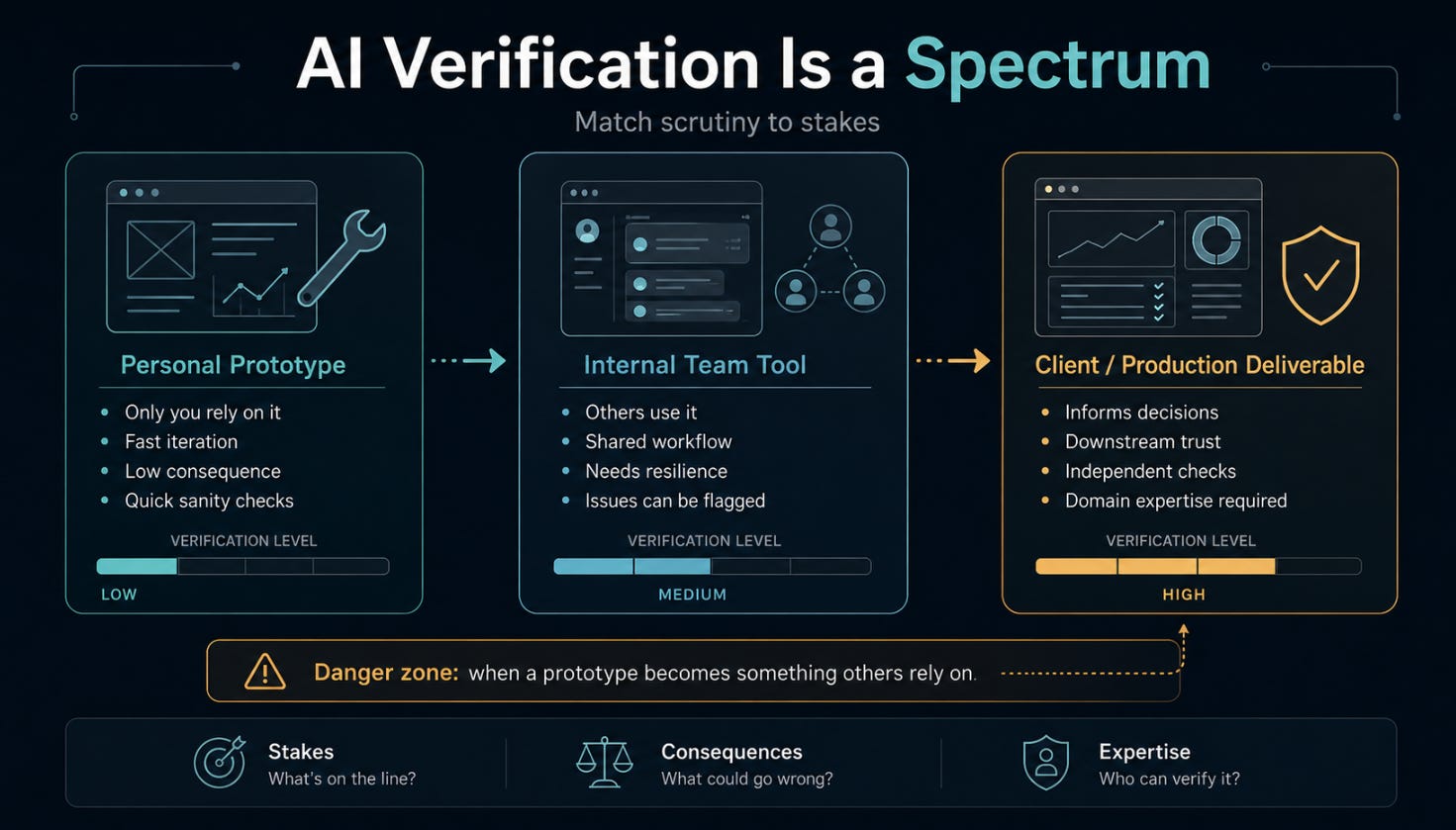
What sits between those two extremes is a spectrum, and where you sit on it should depend on the stakes.
If it’s a personal prototype or you’re trying to take a concept from idea to something visual, the right question is “does it work for me?” or “does this show the idea clearly?” Often that is good enough, and you can later expand it if it is needed for others or start again with more detailed guardrails in place.
If you’re building an internal team tool, others are now using it. It probably needs some resilience built in, and users can flag issues. The level of verification then scales with what the tool is going to be used for and what the impacts are if it gets something wrong.
If you’re building a client-facing deliverable, a facies interpretation, a custom coded app, anything that goes outside your own walls, then full verification is necessary. Edge cases need consideration. Output should be checked against independent data. Someone is going to make a decision based on what you produce, and that decision deserves more than “the code ran.”
Understanding what the stakes are, and noticing when they change, is the part that matters. The tools feel the same regardless of which mode you’re in. The stakes don’t.
Vibe coding has a boundary
OpenAI co-founder Andrej Karpathy’s phrase “vibe coding” captures something real about how these tools feel in practice. You describe what you want, the model generates something close, you nudge it, test it, accept the next suggestion, and keep moving.
There is also a distinction worth noting here, as the term is used loosely. Vibe coding, in the strictest sense means accepting AI generated code without reading it. If you have reviewed and understood what the model produced, then that is something different and it starts to move into AI coding assistant territory.
For personal tools, that can be incredibly effective. You’re not trying to produce perfect software. You’re trying to turn an idea into something usable.
But, vibe coding has a boundary.
The moment the output affects someone else, informs a decision, or becomes part of a client-facing workflow, the mode has to change. You're no longer just exploring. You're engineering, making claims, creating something someone else may trust. That's where verification stops being optional polish and becomes part of the work.
Where it gets dangerous
Here’s the part that concerns me.
When you’re prototyping with Copilot or building something quick with an LLM, there’s a feedback loop. You accept a suggestion. It works. You accept another. That works too. Over time, your threshold for scrutiny starts to drop. Not because you’ve made a conscious decision, but because the pattern of “accept and move on” becomes habitual.
That’s manageable when you’re building something for yourself. It’s not manageable when you’re producing something that someone else will rely on.
The danger isn’t in the prototype phase. It’s in the transition. The moment something moves from “quick tool I built for myself” to “a thing that informs a decision.” If your verification habits don’t shift with that transition, you’re carrying prototype-level scrutiny into production-level stakes.
And this isn’t a problem that only affects people new to a domain. It affects me too.
When I’m working in petrophysics, I have decades of knowledge and experience to fall back on. I can look at a predicted facies log and feel when something is off, even before I’ve checked it formally. But if I were to step outside the areas where I am comfortable, say into another domain or using AI to write code in a framework I haven’t used before then I’m in exactly the same position as anyone else.
The results may look clean and professional, meaning that no alarm bells are raised. This is because I don’t have an independent basis to easily notice when something is wrong.
That’s the real shape of the problem. It’s not “experienced people are safe and inexperienced people aren’t.” It’s that everyone has a set of domains where they can verify meaningfully, and a much larger set of domains where they can’t. The risk shows up wherever the gap between those two sets gets crossed without you noticing.
Generative AI tools can give a confidently wrong answer, and whether that goes unnoticed depends entirely on whether the person reviewing it has independent ground to stand on for that specific task.
What verification actually looks like
When I verify AI output on a client project, I’m not just checking whether the code runs.
I’m asking:
Does this match the geology?
Do these predicted facies make sense given what we know about the depositional environment?
Does the porosity estimate align with the core data?
Are the cuttings descriptions consistent with what the model is suggesting?
Does the code look correct and follow standard practice?
That kind of verification requires:
Domain knowledge
Independent information, i.e data sources the model hasn’t seen
Knowing what “wrong but plausible” looks like in your field
This is the part that worries me about broader AI adoption.
Not the people who have decades of experience and can spot when an output is geologically nonsensical. But, the people who don’t have that background, running the same models, getting clean-looking results, and having no independent basis to question them.
The honest version
I think there’s a version of the AI verification conversation that’s more honest than what we usually hear.
It’s not: “always verify everything.”
It’s: “know what you’re verifying, why it matters, and whether you’re actually equipped to do it.”
I don’t verify my personal tools rigorously because the stakes don’t warrant it. I verify my client work carefully because the stakes do, and because I have the domain expertise to do it in a meaningful way.
The question everyone should be asking isn’t “are you using AI responsibly?” It’s:
Do you know which mode you’re in right now?
Have your verification habits kept pace with the stakes?
And if someone downstream is relying on your output, can you actually check it, or are you just assuming it’s fine because the model seemed confident?
The jagged frontier is personal too
I don’t believe the jagged frontier is just about what AI can and can’t do, I believe it should also be about what you can and can’t verify.
The boundary for that verification can shift depending on the task at hand, the stakes and your own knowledge and expertise.
The people who use AI well aren’t the ones who verify everything obsessively are the ones who skip verification entirely. They’re the ones who calibrate and match their level of scrutiny to the level of consequence.
That’s harder than it sounds. Because the tools can start to feel the same regardless of what you’re building. Copilot doesn’t know whether you’re prototyping a personal tool or shipping production code. The LLM doesn’t flag when the stakes have changed, that part is on you to realise and adapt accordingly.