

Earlier today I came across a post on X from Ryan Sael. He had asked Claude Opus 5.5 to explain camera focus by building an interactive lens lab, and the result, The Plane of Focus. When I saw it I was stunned. It was lovely to look it as well as being fully interactive learning. You turn a focus ring and watch the glass elements move the sharp plane through a scene. It explains the idea by letting you play with it. This is something I wish I had years ago when I was learning all about photography!
As soon as I saw that I thought I had to give that a go and scrambled for ideas. My first thought was “what in petrophysics could do with something like that?”
Over the years I have had to teach petrophysical concepts such as porosity, saturation and permeability using diagrams, equations and crossplots, but the rock never really showed up in most courses. And even when it did, it was still difficult to get across that the pore were even there.
So I asked Claude to help me plan something that would help explain this concept. We wrote a short spec together covering what it should teach, which equations to use and how it should look. I then handed that spec to Claude Code running Opus 5.5.
About an hour later I had a working 3D simulator of pore space and what fills it. I called it Pore Lab, and you can try it at andymcdonald.scot/labs/pore-lab.
I have not yet fully checked the absolute numbers it comes back with, but the whole concept and interactive nature of it is something from another level. I can definitely see it being useful to create these 3D tools to help explain technical concepts and ideas.
What does it do?
Essentially, it is a magnified cube of sandstone sitting on a lab bench. You can see the quartz grains, the clay, the water clinging to the grain surfaces and the oil sitting in the middle of the pores. A small key tells you what each colour is.
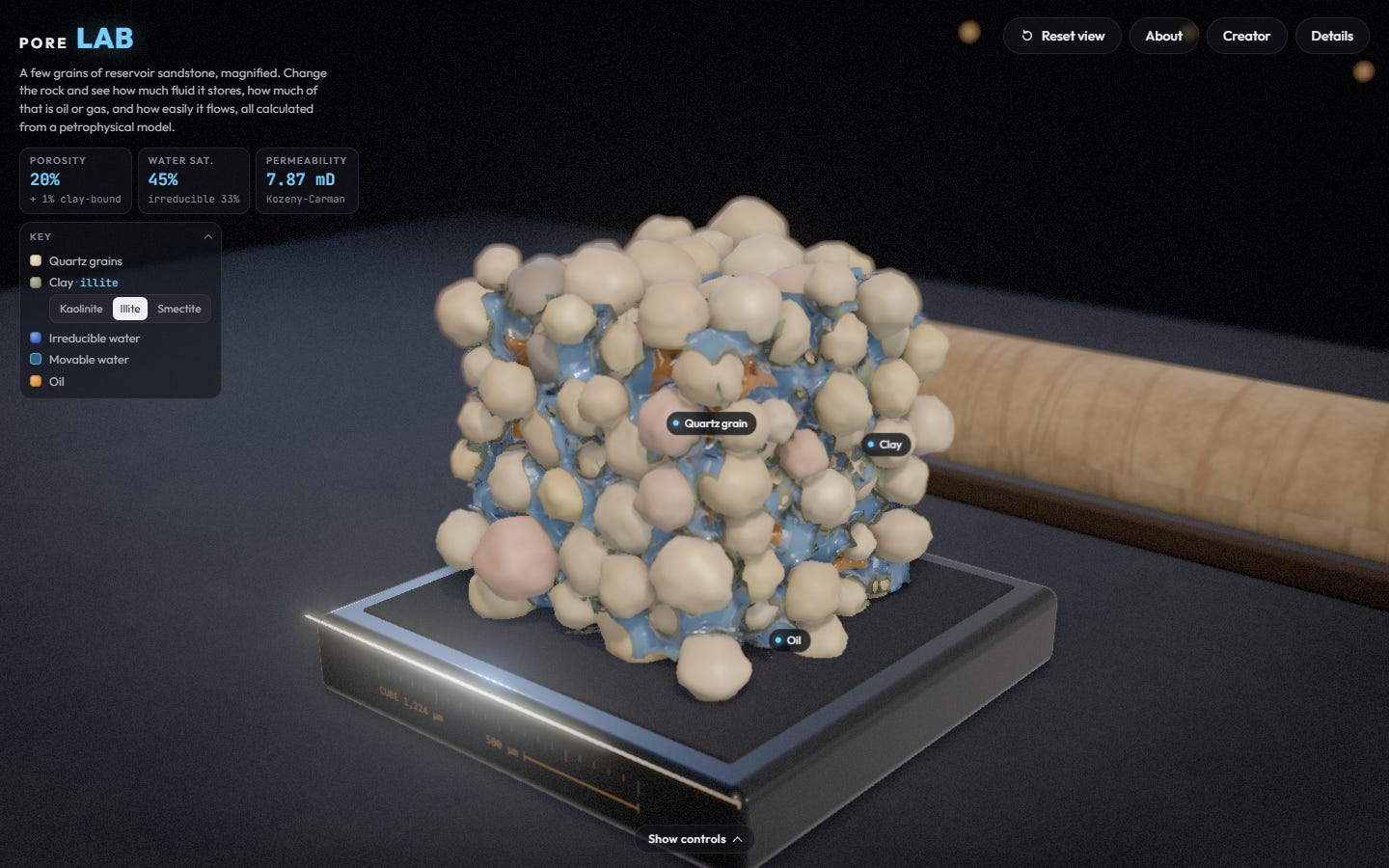
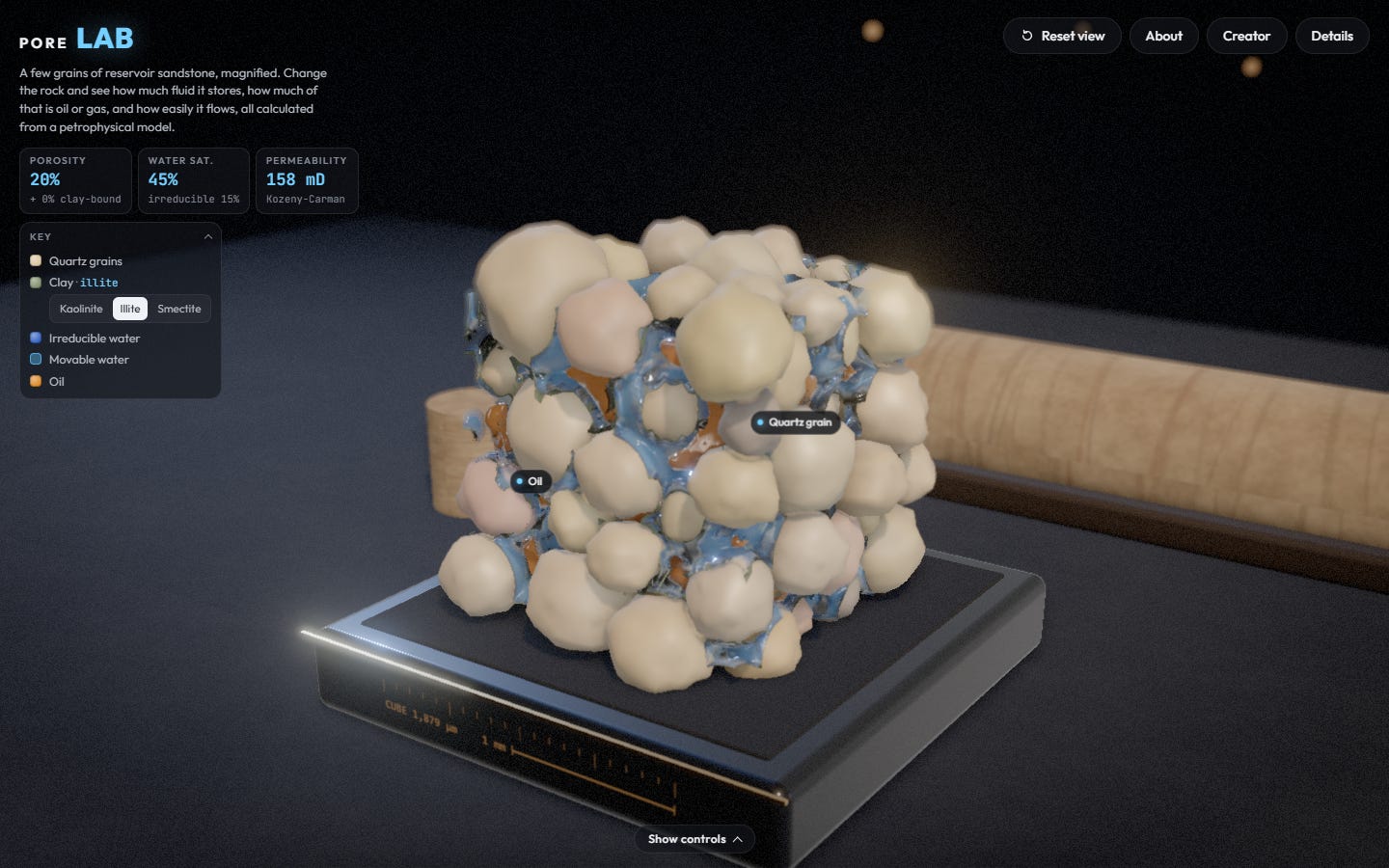
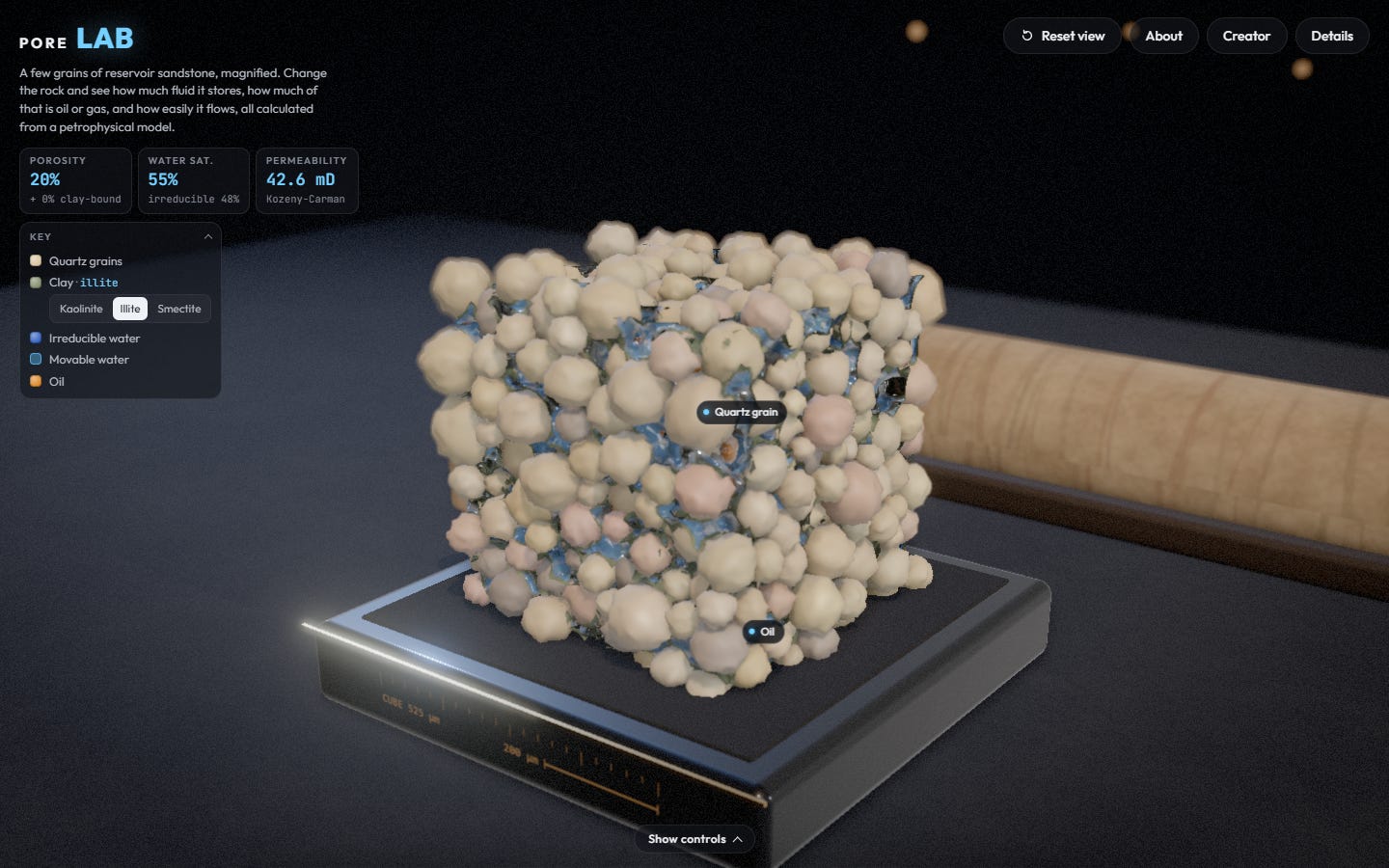
Change the porosity, grain size, clay content or water saturation and the rock rebuilds itself in front of you. We can changes from coarse grains with wide open pores to fine rock with lots of small grains and fine pores.
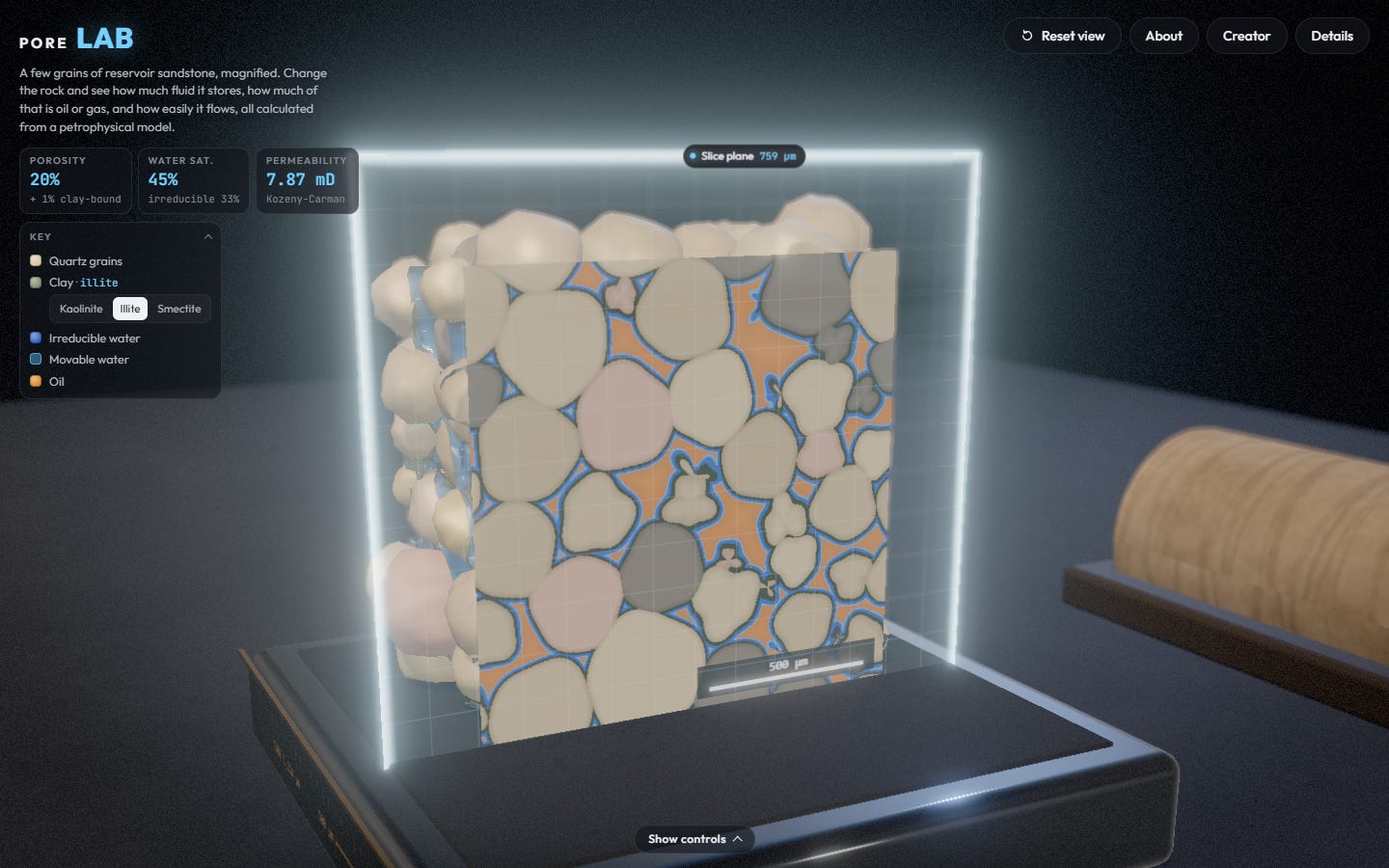
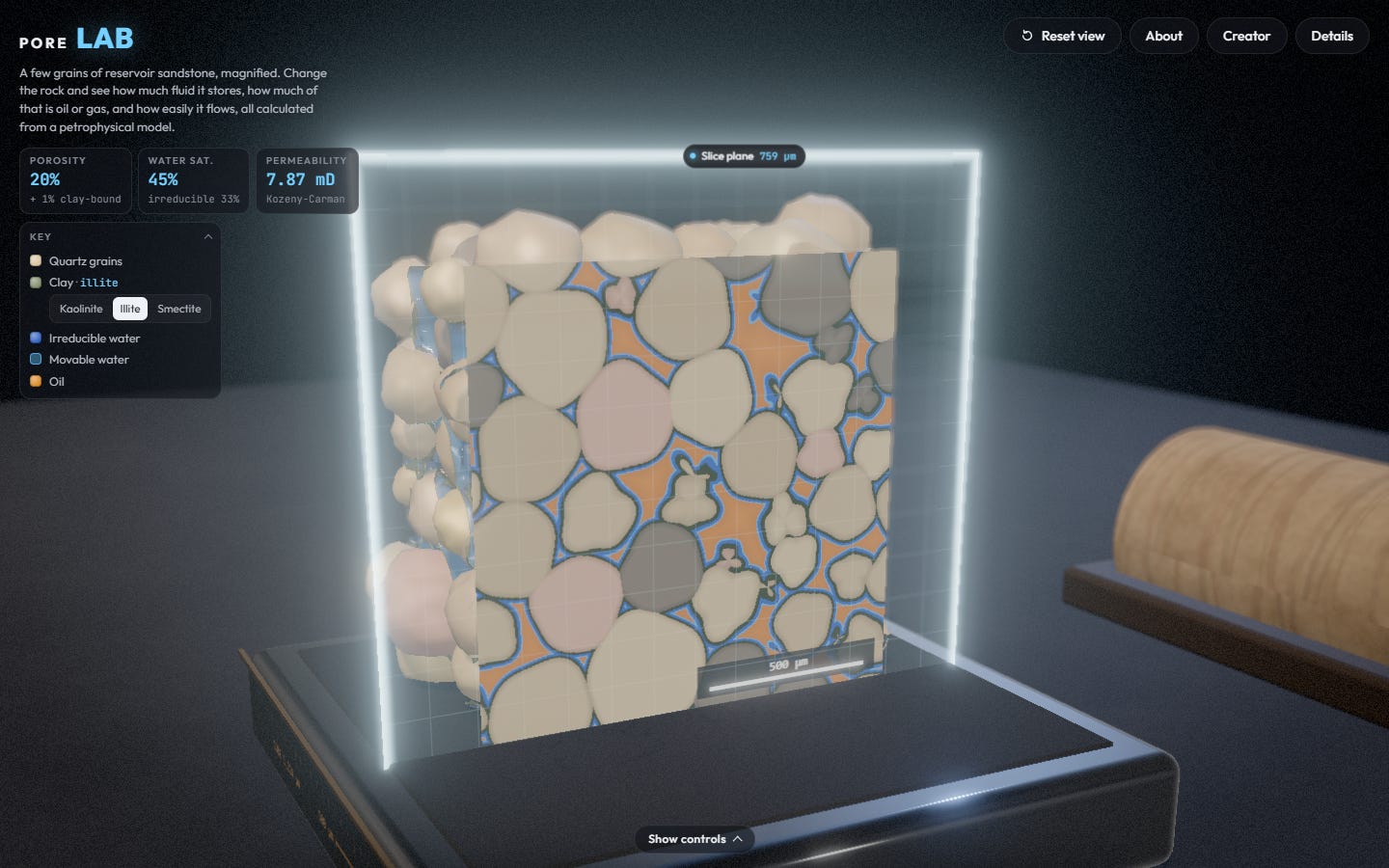
You can also drag a plane through the cube and see a thin section wherever it cuts. This shows the grains, the water films and the oil in the same way we are used to seeing them under a microscope. This will look familiar to anyone who has been on a petrophysics course that talks about porosity and saturation. We often see these, but sometimes it can be difficult to visualise in 3D.
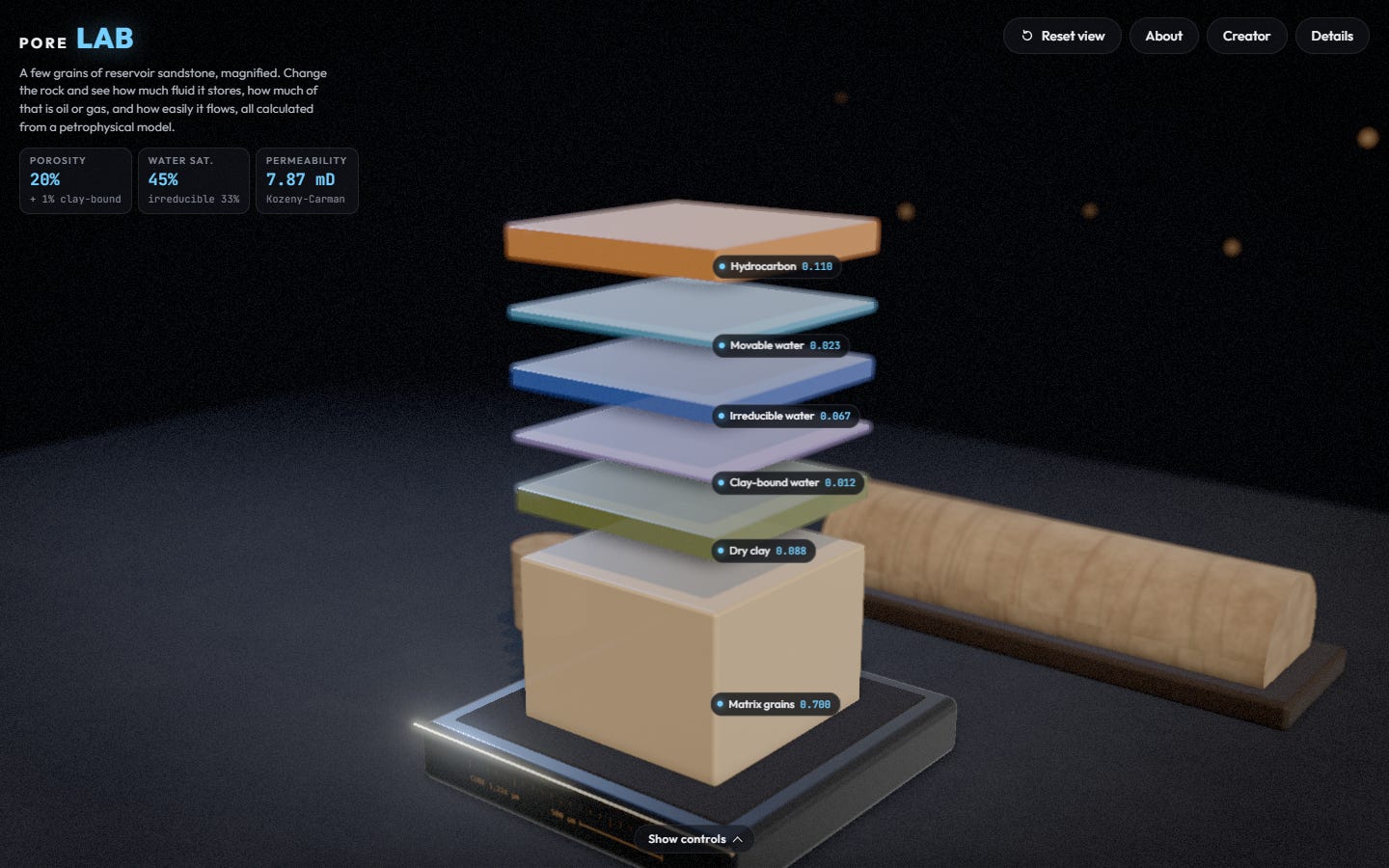
Or you can pull the rock apart into its bulk volumes: grains, clay, bound water, irreducible water, movable water and hydrocarbon, each labelled with its fraction.
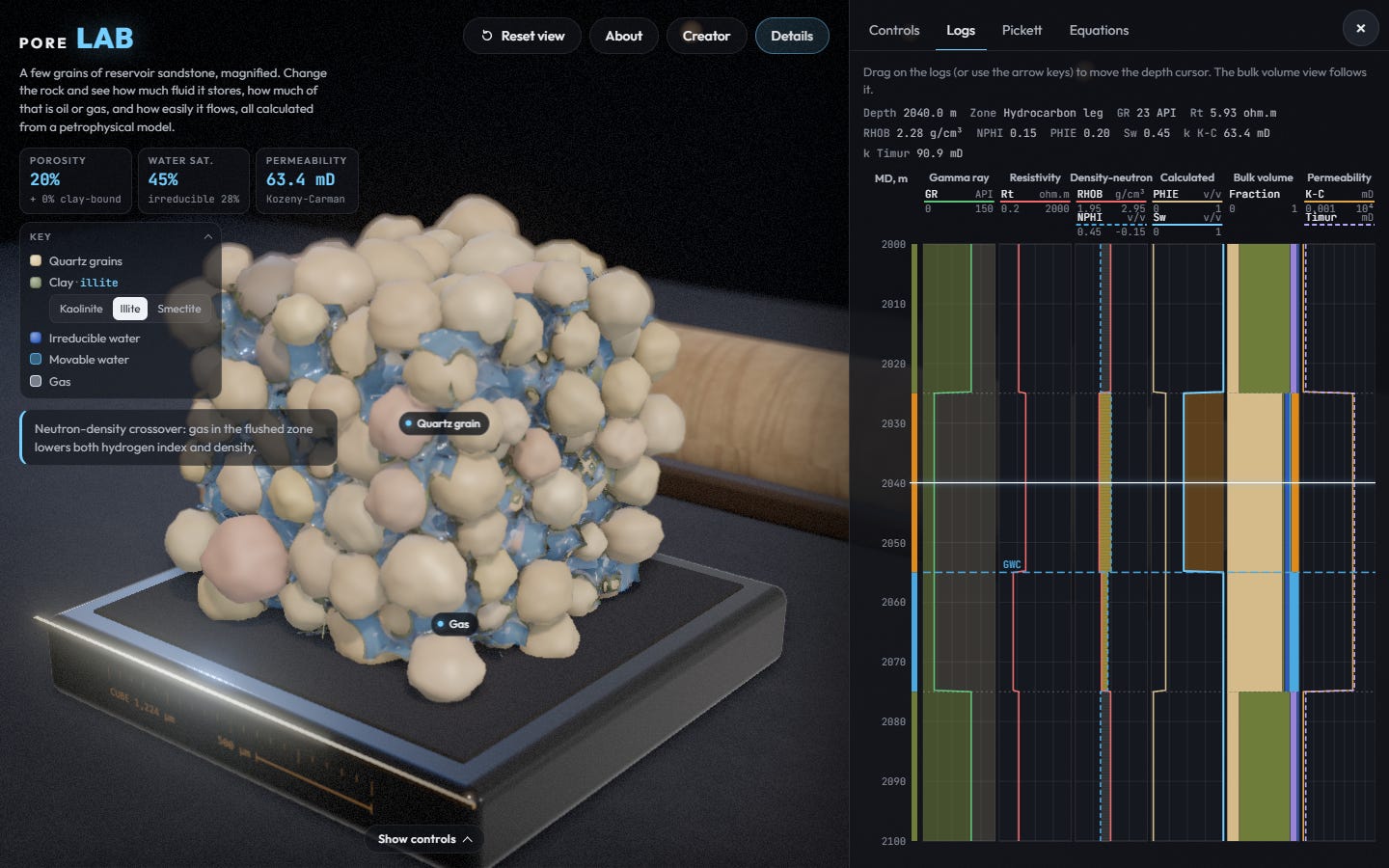
Finally, there is a log viewer. It shows a synthetic well through shale, a hydrocarbon leg and a water leg, all generated from the same model as the cube. Drag the depth cursor and the cube changes to show the rock at that depth.
In summary
Within about an hour of prompting Claude how to build this I came away with a powerful, 3D interactive learning tool explaining porosity, water saturation and the impacts of grain size.
Even though the the physics are simplified and meant for teaching rather than interpretation, it goes to show that with these latest generation of AI models we can better understand and explore technical concepts in ways that we couldn’t before.
Have a play at andymcdonald.scot/labs/pore-lab and try out the different options.